This archive serves as the central memorial space dedicated to Dušan "Duda" Ivković,
a man who did not just coach basketball players, but shaped characters, built institutions,
and defined the very essence of the European school of basketball.
"I am from Crveni Krst. There, we learned that you never leave your friends and that your word is worth more than any piece of paper."
Dušan Duda Ivković
Dušan Ivković was born on October 29, 1943, in Belgrade, during the height of World War II.
He grew up in Crveni Krst (The Red Cross), a neighborhood that would become an
inseparable part of his identity. The Ivković family was deeply rooted in the Serbian intellectual
elite—interestingly, Dušan was a relative of Nikola Tesla (his maternal grandmother, Olga Mandić,
was a close cousin of the famous scientist).
However, Duda’s true academy was BKK Radnički. While his older brother, Slobodan
"Piva" Ivković, became a visionary who modernized Yugoslav basketball, the younger Dušan learned
the trade on the concrete courts of "The Krst." As a player, Duda was the embodiment of loyalty;
he spent an entire decade (1958–1968) in the "Krstaši" jersey, refusing offers from wealthier clubs
because his word and his belonging to the neighborhood were sacred.
2. The Rise of the Professor and the "Triple Crown"
His coaching path began where his playing career ended—at Radnički, working with the youth categories.
However, the spotlight found him in 1978 when he took over Partizan. In the 1978/79 season, Ivković
achieved what was thought impossible for such a young coach: he won the Yugoslav Championship, the
Yugoslav Cup, and the international FIBA Korać Cup. That "Triple Crown" was a clear announcement of
a genius who viewed basketball as mathematical precision blended with artistic freedom.
3. Architect of the Golden Generation
A generation that became history
In the late 1980s, Ivković took over the Yugoslavia national team. This was the period of creating
the most powerful team in the history of European basketball. Under his leadership, Dražen Petrović,
Vlade Divac, Toni Kukoč, and Dino Rađa became an unstoppable force. The gold medals in Zagreb (1989),
Buenos Aires (1990), and Rome (1991) were not just successes; they were demonstrations of power by a
team Ivković disciplined to play "total basketball."
4. Athens 1995: The Return of the Outcasts
The most difficult and most brilliant moment of his career was the return from international isolation.
Ivković kept the spirit of the national team alive for three years without official matches, leading the
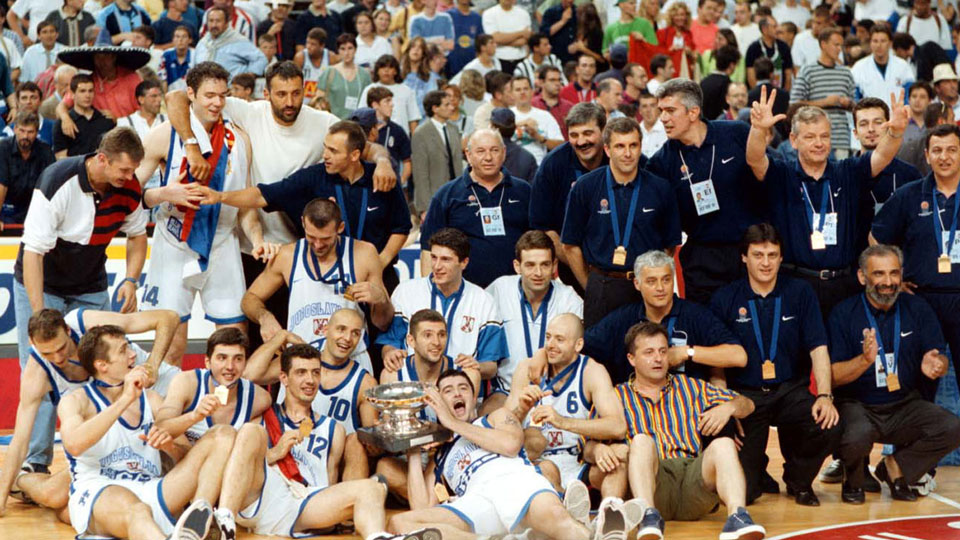
team on tours under assumed names. When sanctions were lifted for the 1995 European Championship in Athens,
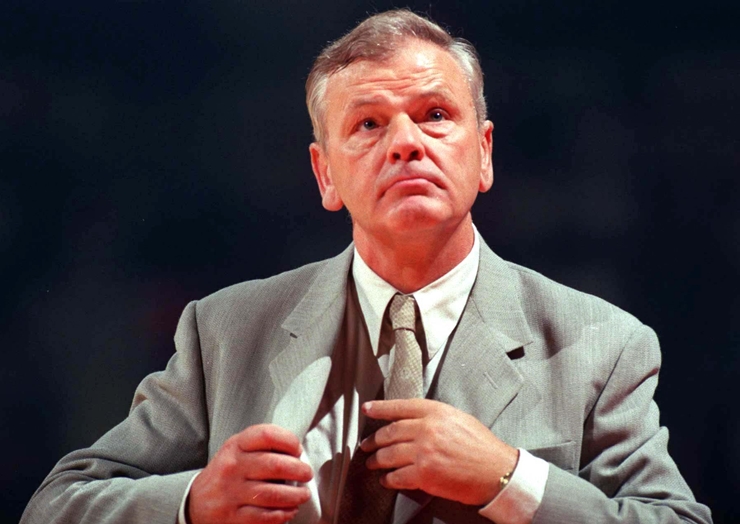
Duda led the team through "Balkan hell" to gold against Lithuania. The image of Duda standing calm while
the arena burned with emotion became a symbol of the invincibility of Serbian basketball.
5. The European Prince and the Russian Renaissance
His club career in Greece and Russia was a series of lessons in dominance. With Olympiacos, he won
everything in 1997, and then returned 15 years later to perform the famous "comeback against destiny"
in Istanbul 2012 with an underdog squad. In Moscow, he turned CSKA into a modern empire, setting
standards of professionalism that Russian basketball had never seen before.
6. The Pigeon Fancier and Guardian of Tradition
Off the court, Duda was a man of the "old school." His passion for racing pigeons was his meditation.
He often said that pigeons provided him with a peace that a basketball arena could not. He was the last
"Master of the Krst," a man who could talk to kings and presidents but would always return to his friends
on the Belgrade cobblestones.
II. Detailed Career Chronology
Detailed Career Chronology
1968–1978
BKK Radnički
Youth / Assistant — Foundational education of future legends
1978–1980
KK Partizan
Head Coach — First "Triple Crown" in club history
1980–1982
Aris Thessaloniki
Head Coach — Laying the foundations for the rise of Greek basketball
1984–1987
Šibenka
Head Coach — Mentorship of a young Dražen Petrović
1988–1995
Yugoslavia (SFR/FR)
Head Coach — The most successful period in national team history
1996–1999
Olympiacos
Head Coach — Club's first-ever EuroLeague title (1997)
1999–2001
AEK Athens
Head Coach — Winning the Saporta Cup and two national Cups
2002–2005
CSKA Moscow
Head Coach — Building a modern European giant
2008–2013
Serbia
Head Coach — Revitalizing the cult of the national team
2010–2012
Olympiacos
Head Coach — Legendary EuroLeague title in Istanbul (2012)
III. Vault of Success (Official Factography)
Vault of Success
Club Competitions (20 Major Trophies)
EuroLeague — Olympiacos1997, 2012
Saporta Cup (Cup Winners' Cup) — AEK Athens2000
FIBA Korać Cup (International) — Partizan1979
ULEB Cup (EuroCup) — Dynamo Moscow2006
Yugoslav League — Partizan1979
Greek League — PAOK, Olympiacos1992, 1997, 2012
Russian League — CSKA Moscow2003, 2004, 2005
Turkish Cup — Anadolu Efes2015
National Team Medals
World Championship — YugoslaviaGold, 1990
European Championship — YugoslaviaGold, 1989, 1991, 1995
Olympic Games — YugoslaviaSilver, 1988
European Championship — SerbiaSilver, 2009
Universiade — YugoslaviaGold, 1987
IV. Thoughts and Testimonials
Thoughts and Testimonials
The Philosophy of Dušan Ivković
On Knowledge: "A coach must never stop learning. The day you think you know everything, your career is over."
On Loyalty: "I am from Crveni Krst. There, we learned that you never leave your friends and that your word is worth more than any piece of paper."
On Youth: "The point is not to win today; the point is to create a player who will win for the next ten years."
"He was my basketball father. Every time I had a dilemma, I would call him. His departure is the end of an era."
Željko Obradović
"He saw in me what no one else did. He believed in me when I doubted myself. He was a general we followed with our eyes closed."
Vasilis Spanoulis
"Ivković was one of the greatest minds to ever hold a clipboard."